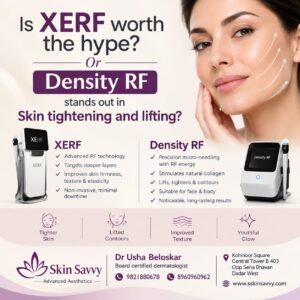
Yes, but with caveats. Much of the celebrity buzz around XERF stems from three factors:
- Instant event-readiness: It provides immediate contouring and de-puffing without visible downtime or bruising.
- Dual-frequency mechanism: Unlike conventional monopolar RF devices operating strictly at 6.78 MHz, XERF combines 6.78 MHz and 2 MHz. The 2 MHz wavelength delivers heat deeper past the reticular dermis into the deep subcutaneous and fascial support structures, producing more noticeable mechanical lifting/vector repositioning rather than just surface tightening.
- High patient comfort: Its advanced surface-cooling system allows higher thermal delivery with substantially less pain than legacy systems.
However, the hype can be misleading if framed as a replacement for surgical lifting or significant volume restoration. XERF works best for mild-to-moderate laxity, early jowl formation, and submental heaviness, but cannot correct severe skin redundancy or volume deflation.
Comparative Analysis: XERF vs. Density RF vs. Thermage FLX
| Parameter | Thermage FLX | Density RF (Jeisys) | XERF |
| RF Modality & Frequency | Monopolar RF only (6.78 MHz) | Monopolar + Bipolar sequential delivery (Density Alpha tip; 6.78 MHz) | Dual-Frequency Monopolar RF (6.78 MHz + 2 MHz) |
| Primary Target Depth | Deep dermis / upper sub-Q (uniform 3D dermal volumetric heating) | Dermis (Monopolar deep + Bipolar upper dermal superficial coverage) | Deep reticular dermis down to superficial fascia/deep soft-tissue septa |
| Primary Clinical Indication | Dermal redensification, crepey skin, fine elastosis, global tightening | Dermal elasticity, pore refinement, surface compacting, skin thickness | Lower-face contouring, jowl lifting, submental definition, vector repositioning |
| Tightening vs. Lifting Bias | 100% Tightening (shrink-wrap/density) | 100% Tightening (dual-layer density) | ~70% Lifting / 30% Tightening |
| Comfort / Pain Profile | Moderate–High (sharp thermal sensation; requires vibration/cooling) | Mild–Moderate (efficient cryogenic spray cooling with impedance match) | Mild–Moderate (controlled multi-level cooling; generally very well-tolerated) |
| Clinical Track Record | Global gold standard (20+ years of peer-reviewed clinical validation) | Strong, clinically validated Korean platform gaining rapid global adoption | Newer generation; strong early adoption in top Korean and international aesthetic clinics |
Which is Better for Your Goals?
- For True Vector Lifting & Lower-Face Sculpting: XERF has an edge. The addition of 2 MHz reaches deeper structural planes, yielding better lower-third elevation, jawline sharpening, and reduction in jowl heaviness compared to pure dermal tightening devices.
- For True Dermal “Tightening” & Skin Density:Thermage FLX and Density RF remain superior.
- If the primary issue is thinning, crepey skin, or fine lines, Thermage delivers proven volumetric dermal compacting.
- Density RF offers a distinct advantage over Thermage via its Alpha tip by delivering monopolar and bipolar energy in a single pulse—compacting both upper papillary dermis and deeper reticular dermis simultaneously with lower consumable costs and greater comfort.
Frequently Asked Questions (FAQs)
1. What is the fundamental difference between skin tightening and skin lifting?
- Tightening refers to contracting existing dermal collagen fibers and boosting dermal density/thickness (reducing crepiness, pore visibility, and fine laxity).
- Lifting refers to upward vector repositioning of descended soft tissues and fat compartments (redefining the jawline, reducing nasolabial/marionette fold overhang, and elevating jowls).
2. How many sessions are required for each treatment?
- Thermage FLX: Single session; results develop over 3–6 months and typically maintained annually.
- Density RF: Typically a single annual session, though patients with advanced laxity may opt for a booster at 6 months.
- XERF: Significant contouring is visible after 1 session, but protocols frequently recommend 1–2 sessions spaced 4 to 8 weeks apart for optimal structural lifting, followed by maintenance every 9–12 months.
3. How soon do results appear, and how long do they last?
- Immediate (Days 1–7): Mild contraction of existing collagen triple-helix structures and transient edema creates an immediate, fresh tightening or sculpting effect.
- Long-Term (Months 2–6): Neocollagenesis and neoelastogenesis peak at 3 to 6 months. Results typically last 12 to 18 months, depending on intrinsic aging, UV exposure, and lifestyle.
4. Can these treatments cause facial fat atrophy or hollow cheeks?
Monopolar RF energy flows along pathways of electrical impedance. Because subcutaneous adipose tissue has high resistance, improper bulk heating at excessive fluence can theoretically lead to fat atrophy. Modern systems mitigate this:
- Thermage FLX uses real-time continuous impedance tuning (AccuREP).
- Density RF measures impedance with each shot to modulate output safely.
- XERF controls depth selectivity via frequency switching, directing bulk thermal energy precisely. In thin, hollow faces, experienced practitioners adjust shot counts and energy vectoring away from buccal zones to avoid unwanted volume depletion.
5. Can XERF or Density RF be combined with other modalities?
Yes. Multi-modality stacking produces synergistic outcomes:
- With Micro-focused Ultrasound (HIFU/Ultherapy): Targeting SMAS with ultrasound, while using RF (Density/Thermage) for dermis or XERF for deep subcutaneous structures.
- With Biostimulators (PLLA/PDLLA/CaHA): Staging RF 4–6 weeks apart from biostimulatory injectables maximizes extracellular matrix rebuilding without degrading injectable product.