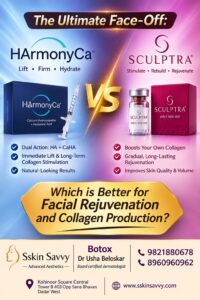
HArmonyCa vs Sculptra: Which Is Better for Facial Rejuvenation?
Choosing between HArmonyCa and Sculptra can be confusing if your goal is firmer skin, improved facial contours and natural-looking rejuvenation without surgery. Both treatments stimulate collagen production, but they work differently. HArmonyCa combines hyaluronic acid (HA) with calcium hydroxyapatite (CaHA) to provide an immediate volumising effect alongside collagen stimulation, whereas Sculptra uses poly-L-lactic acid (PLLA) to encourage gradual collagen production and restore facial volume over time. The appropriate choice depends on your facial anatomy, degree of volume loss, skin laxity, desired results and medical suitability.
HArmonyCa vs Sculptra: Quick Comparison
HArmonyCa and Sculptra are injectable biostimulators designed to address signs of facial ageing. The main difference is their composition and how they produce aesthetic improvement. HArmonyCa combines an HA-based immediate volumising component with CaHA-based collagen stimulation, while Sculptra relies on PLLA-driven collagen stimulation for progressive improvement.
Feature| HArmonyCa| Sculptra
Main ingredients| Hyaluronic acid + calcium hydroxyapatite| Poly-L-lactic acid (PLLA)
Treatment category| Hybrid injectable filler and biostimulator| Collagen biostimulator
Primary mechanism| Immediate HA-related volume plus CaHA-associated collagen stimulation| Gradual collagen stimulation
Initial appearance| Immediate correction from the HA gel, with possible swelling| Initial fullness can be temporary from injection fluid and swelling
Collagen stimulation| Yes| Yes
Treatment approach| Often a single initial session, sometimes with a touch-up depending on assessment and local product instructions| Commonly a series of sessions
Visible improvement| Some improvement immediately, with further tissue changes developing over time| Gradual improvement over weeks and months
Longevity| Depends on treatment area, technique and individual response; no universal duration should be assumed| Clinical data support improvement lasting up to approximately 24 months in studied indications
Reversibility| Not readily dissolved with hyaluronidase because it also contains CaHA| Not dissolved by hyaluronidase
Main considerations| Placement, tissue characteristics and CaHA-related risks| Reconstitution, injection technique and potential delayed nodules
Important: These are not interchangeable products. Their approved indications, formulation, injection protocols and availability differ by country. Individual results and treatment plans vary.
What Is HArmonyCa?
HArmonyCa is a hybrid injectable aesthetic treatment manufactured by Allergan Aesthetics. It combines two components: hyaluronic acid and calcium hydroxyapatite.
Unlike a conventional hyaluronic acid filler, which primarily adds volume through gel-based tissue support, HArmonyCa combines immediate volumising properties with the longer-term collagen-stimulating activity associated with calcium hydroxyapatite.
How Does HArmonyCa Work?
HArmonyCa works through two complementary mechanisms.
- Immediate volumising effect from hyaluronic acid
Hyaluronic acid is a naturally occurring substance in the human body that attracts and binds water. In injectable formulations, cross-linked HA gel provides structural support and contributes to immediate facial volume and contour improvement.
- Collagen stimulation from calcium hydroxyapatite
Calcium hydroxyapatite consists of biocompatible mineral microspheres. Following injection, the material provides a scaffold around which the body’s tissue response develops, including collagen production.
This process can contribute to improved skin firmness, tissue support and facial contour over time.
The Australian manufacturer information describes HArmonyCa Lidocaine as containing 20 mg/ml cross-linked sodium hyaluronate, calcium hydroxyapatite microspheres and lidocaine. Formulations should always be verified against the specific product supplied in the relevant country.
What Are the Benefits of HArmonyCa?
Potential benefits include:
- Immediate improvement in facial volume and contour.
- Collagen stimulation over time.
- Improved appearance of selected areas of facial laxity.
- Support for facial contour definition.
- A combined volumising and biostimulating approach.
- Potential improvement in skin firmness and tissue quality.
What Areas Can HArmonyCa Treat?
Depending on the local product instructions and clinical assessment, treatment may be considered for selected facial areas, particularly where structural support and improved contour are desired.
Commonly discussed areas include:
- Midface and cheek region.
- Lateral cheek.
- Selected areas of facial laxity.
- Facial contour and jawline.
The exact treatment areas must follow the product’s local instructions for use. Not every anatomical area is suitable for this injectable.
How Long Does HArmonyCa Last?
There is no universally established duration that applies to every HArmonyCa patient.
The longevity of the aesthetic result depends on several factors:
- Individual metabolism and tissue response.
- Treatment area and facial anatomy.
- Injection depth and placement.
- Product distribution and treatment volume.
- Baseline skin quality and degree of laxity.
- Ageing progression and lifestyle factors.
The manufacturer’s patient information describes the correction as temporary and notes that repeat treatment may be required.
It is therefore more accurate to assess HArmonyCa longevity individually rather than promise a fixed number of months.
What Is Sculptra?
Sculptra is an injectable collagen biostimulator manufactured by Galderma. Its active ingredient is poly-L-lactic acid (PLLA), a biodegradable synthetic polymer.
Unlike traditional fillers that primarily provide immediate gel-based volume, Sculptra stimulates the body’s collagen-producing response.
As collagen develops, the treated area can gradually regain volume, improve structural support and show a reduction in the appearance of wrinkles and facial volume loss.
How Does Sculptra Work?
Sculptra works through a gradual biological process.
After injection, PLLA microparticles interact with surrounding tissue and stimulate a controlled tissue response that promotes new collagen formation.
Over the following weeks and months, this collagen production contributes to progressive improvement in facial volume and skin structure.
The initial fullness immediately after treatment should not be mistaken for the final result. Some of this early appearance comes from the injection fluid and temporary swelling.
What Are the Benefits of Sculptra?
Potential benefits include:
- Gradual restoration of lost facial volume.
- Stimulation of natural collagen production.
- Improvement in selected facial wrinkles and contour deficiencies.
- Progressive rather than immediate aesthetic change.
- Long-lasting improvement in appropriately selected patients.
- A treatment approach that focuses on rebuilding tissue support rather than simply adding gel volume.
What Areas Can Sculptra Treat?
Depending on local regulatory approval and product instructions, Sculptra may be used for selected facial indications, including:
- Cheeks.
- Nasolabial folds.
- Selected facial volume-deficient areas.
- Other indicated facial wrinkles and contour deficiencies.
It is not suitable for every facial region. For example, the US patient information specifically advises against injection into the lips and periocular area.
How Long Does Sculptra Last?
Sculptra has clinical evidence supporting aesthetic improvement lasting up to approximately two years in studied indications.
The FDA’s 2023 approval update reports that patients in the relevant clinical study received up to four injections and that results may last up to 24 months.
However, longevity depends on the patient’s baseline condition, treatment regimen, individual collagen response and the indication being treated.
HArmonyCa vs Sculptra: 7 Important Differences
Understanding their clinical differences is more useful than comparing their brand names alone.
- Composition: HA and CaHA vs PLLA
HArmonyCa contains two active structural components:
- Hyaluronic acid.
- Calcium hydroxyapatite.
Sculptra contains poly-L-lactic acid microparticles in a reconstituted suspension.
The presence of HA in HArmonyCa contributes to immediate volumisation, while its CaHA component supports collagen stimulation.
Sculptra does not contain an HA gel component. Its primary aesthetic effect develops through progressive collagen stimulation.
- Immediate Results vs Gradual Results
This is one of the most important differences for patients.
HArmonyCa can provide an immediate contouring effect because of its HA component. Subsequent collagen-related tissue changes develop over time.
Sculptra is designed for gradual improvement. Patients may initially notice fullness from the injection fluid, but this temporary effect subsides. The lasting improvement develops as collagen production increases.
Practical distinction: Someone seeking an immediate degree of facial contour improvement may discuss HArmonyCa with their practitioner, whereas someone comfortable with progressive volume restoration may discuss Sculptra.
Neither treatment guarantees a particular degree of lifting.
- Number of Treatment Sessions
HArmonyCa is often planned as an initial treatment session, with a follow-up assessment and possible touch-up when clinically appropriate.
Sculptra generally involves multiple treatment sessions.
Galderma’s US patient information describes an average of two to three treatment sessions over several months, although the actual number varies.
The appropriate number of sessions depends on the treatment indication, facial anatomy, product instructions and desired correction.
- Collagen Stimulation
Both treatments stimulate collagen, but their biomaterials and tissue responses differ.
HArmonyCa uses calcium hydroxyapatite microspheres as its biostimulating component.
Sculptra uses PLLA microparticles to stimulate collagen production through a controlled tissue response.
Neither should be described as simply replacing lost collagen. The body’s biological response is an essential part of both treatments.
- Longevity of Results
Sculptra has a more established clinical evidence base for long-term outcomes, including published data supporting results lasting up to approximately 24 months in studied indications.
HArmonyCa has published clinical studies showing improvements in aesthetic outcomes and tissue characteristics, but its evidence base and product-specific follow-up data should not be assumed to establish the same duration.
It is important to distinguish between manufacturer claims, observational findings and long-term controlled clinical evidence.
- Reversibility
This is an important consideration before choosing either injectable.
Hyaluronidase can dissolve suitable hyaluronic acid filler gels. However, HArmonyCa is a hybrid HA/CaHA product. Dissolving its HA component does not dissolve the calcium hydroxyapatite component.
Sculptra is also not reversible using hyaluronidase.
Neither product should be selected on the assumption that an unwanted result can simply be dissolved.
- Side Effects and Safety Considerations
Both treatments are medical procedures and can cause adverse effects.
Common or recognised complications include:
- Swelling.
- Bruising.
- Tenderness.
- Redness.
- Injection-site discomfort.
- Lumps or nodules.
- Infection.
- Inflammatory reactions.
Sculptra has recognised risks of delayed-onset papules and nodules, which may develop weeks or months after treatment.
HArmonyCa also carries risks associated with injectable fillers and CaHA-containing products, including nodules, inflammatory reactions and vascular complications.
A particularly important risk with facial injectable treatments is accidental injection into a blood vessel. This can result in tissue necrosis, visual impairment, blindness or stroke.
Patients should seek immediate medical attention if they experience unusual severe pain, skin blanching or colour changes, or visual disturbances during or after injection.
HArmonyCa vs Sculptra: Which Is Better for Different Skin Concerns?
There is no universally superior treatment. The decision should be based on the underlying aesthetic concern rather than simply choosing the product with the most popular reputation.
Patient concern| Treatment to discuss with your practitioner| Clinical reasoning
Immediate contour improvement| HArmonyCa| HA component provides immediate volumising support
Gradual facial volume restoration| Sculptra| Progressive collagen stimulation
Facial volume loss| Both| Depends on the distribution and severity of volume loss
Selected areas of skin laxity| HArmonyCa| Hybrid volumising and biostimulating properties
Progressive collagen stimulation| Both| Different biomaterials and mechanisms
Preference for fewer initial sessions| HArmonyCa may be considered| Often planned as one initial session
Preference for gradual results| Sculptra| Designed for progressive improvement
HArmonyCa for Skin Laxity and Facial Contouring
HArmonyCa may be considered when the treatment objective includes immediate contour support alongside collagen stimulation.
For example, a patient with mild to moderate lateral cheek laxity and reduced facial definition may benefit from a carefully planned assessment of whether a hybrid injectable is appropriate.
However, significant skin excess, severe tissue descent or substantial structural volume loss may require a different treatment strategy.
Sculptra for Facial Volume Loss and Collagen Restoration
Sculptra may be considered when gradual improvement in facial volume and tissue support is the primary objective.
For example, an individual with diffuse facial volume depletion and age-related hollowing may be assessed for a staged collagen-stimulation treatment plan.
It is important to understand that Sculptra is not an instant lifting treatment.
Can HArmonyCa and Sculptra Be Combined?
In selected patients, a practitioner may consider different injectable treatments as part of a comprehensive facial rejuvenation plan.
However, combining HArmonyCa and Sculptra should not be considered a routine requirement or a proven superior approach.
The decision requires consideration of:
- Existing filler history.
- Previous biostimulator treatments.
- Facial anatomy and tissue thickness.
- Product placement and treatment timing.
- Potential inflammatory reactions.
- Cumulative volume and tissue response.
- Evidence and local product instructions.
A treatment plan should be individualised. Using multiple collagen stimulators does not automatically produce better results.
Who Is a Suitable Candidate for HArmonyCa or Sculptra?
A suitable candidate generally has realistic expectations, appropriate facial anatomy and no contraindication to the proposed treatment.
A consultation should assess:
- Age-related facial volume changes.
- Skin elasticity and laxity.
- Facial fat distribution.
- Existing filler or implant history.
- Previous aesthetic procedures.
- Allergies and medical conditions.
- Pregnancy or breastfeeding status.
- Current medications.
- History of abnormal scarring or inflammatory conditions.
Patients with active infections or inflammation in the intended treatment area should generally postpone elective injections until the condition has been appropriately addressed.
Pregnancy and breastfeeding require particular caution because safety has not been established for these elective treatments.
The practitioner should review the specific product’s current instructions for use before proceeding.
Which Is More Cost-Effective: HArmonyCa or Sculptra?
The cost comparison should consider the complete treatment plan rather than the price of an individual syringe or vial.
Factors affecting total treatment expenditure include:
- Product quantity.
- Number of treatment sessions.
- Practitioner expertise.
- Clinic location.
- Treatment complexity.
- Follow-up consultations.
- Potential maintenance treatments.
HArmonyCa may involve fewer initial sessions in some treatment plans, whereas Sculptra commonly requires a series of treatments.
However, fewer sessions do not automatically mean lower overall costs or better value.
Patients should request a complete treatment quotation that explains the product, quantity, expected sessions, follow-up requirements and any additional costs.
HArmonyCa vs Sculptra: What Does Clinical Research Say?
Evidence quality is important when comparing aesthetic treatments.
Research on HArmonyCa
A 2023 study published in Plastic and Reconstructive Surgery – Global Open investigated a hybrid HA/CaHA injectable in 15 participants.
The study reported increased dermal thickness on ultrasound at 90 and 120 days, alongside positive aesthetic assessments.
Another prospective study published in the Journal of Cosmetic Dermatology in 2023 evaluated HArmonyCa using photography, ultrasound and elastography.
These studies provide preliminary clinical evidence supporting the treatment’s potential benefits. However, small sample sizes and limited follow-up mean that they cannot establish long-term superiority over other collagen stimulators.
Research on Sculptra
Sculptra has a longer clinical research history involving PLLA-based collagen stimulation.
The FDA’s 2023 approval update for correction of cheek-region fine lines and wrinkles reported that clinical study participants received up to four injections and that improvements could last up to 24 months.
Galderma’s published patient information also describes an average treatment course of two to three sessions.
Is There a Direct Clinical Comparison?
There is currently insufficient robust head-to-head clinical evidence to establish that HArmonyCa is more effective than Sculptra, or vice versa, across all facial ageing concerns.
Studies involving different products, patient populations, injection protocols and follow-up periods cannot be directly compared as though they were part of the same clinical trial.
The evidence-based conclusion is that both treatments have distinct clinical applications, and the selection should be based on patient assessment, product-specific evidence and practitioner expertise.
Frequently Asked Questions About HArmonyCa vs Sculptra
- Is HArmonyCa better than Sculptra?
Neither is universally better. HArmonyCa combines immediate HA-based volumisation with CaHA-associated collagen stimulation, while Sculptra stimulates gradual collagen production using PLLA. The choice depends on facial anatomy, treatment goals, desired timing of improvement and individual suitability.
- Does HArmonyCa give faster results than Sculptra?
HArmonyCa can provide an immediate volumising effect because it contains hyaluronic acid. Its collagen-related effects develop over time. Sculptra works more gradually, with lasting improvement developing as collagen production increases.
- Which lasts longer, HArmonyCa or Sculptra?
Sculptra has clinical evidence supporting improvement lasting up to approximately 24 months in studied indications. HArmonyCa longevity varies by individual and treatment area. There is insufficient direct comparative evidence to establish that one consistently lasts longer than the other.
- How many sessions of HArmonyCa are needed?
HArmonyCa is commonly planned as one initial treatment session. Some patients may require a follow-up assessment or additional treatment. The decision depends on individual anatomy, the treatment indication and the product’s local instructions.
- How many sessions of Sculptra are needed?
An average Sculptra treatment course may involve two to three sessions over several months. Some patients may need fewer or additional sessions depending on their degree of volume loss and treatment response.
- Can HArmonyCa dissolve like regular hyaluronic acid fillers?
No. Although HArmonyCa contains hyaluronic acid, it also contains calcium hydroxyapatite. Hyaluronidase may break down the HA component, but it does not dissolve the CaHA microspheres.
- Does Sculptra give an immediate facelift?
No. Sculptra is a gradual collagen stimulator, not an instant facelift. Temporary fullness immediately after injection can result from fluid and swelling. The longer-term improvement develops over weeks and months.
- Is HArmonyCa suitable for older patients?
Age alone does not determine suitability. Facial anatomy, tissue quality, skin laxity, volume distribution, medical history and treatment expectations are more important considerations. A qualified practitioner must determine whether the treatment is appropriate.
- Can HArmonyCa and Sculptra be used together?
They may be considered within a carefully planned treatment strategy for selected patients. However, combining them is not necessary for everyone, and there is insufficient comparative evidence establishing that combination treatment produces superior results.
- Which treatment is better for natural-looking results?
Both can produce natural-looking improvements when appropriately selected and administered. HArmonyCa provides an immediate volumising component, whereas Sculptra produces more gradual changes. The quality of the outcome depends heavily on treatment planning, facial anatomy and practitioner technique.
Final Verdict: HArmonyCa or Sculptra?
HArmonyCa and Sculptra are two different approaches to non-surgical facial rejuvenation.
HArmonyCa combines hyaluronic acid and calcium hydroxyapatite to provide immediate volumising support alongside collagen stimulation. Sculptra uses poly-L-lactic acid to encourage gradual collagen production and progressive facial volume restoration.
If immediate contour support alongside collagen stimulation is an important treatment objective, HArmonyCa may be worth discussing with your practitioner.
If gradual collagen-driven improvement and progressive volume restoration are the primary goals, Sculptra may be an appropriate option.
Ultimately, the most suitable treatment is the one that addresses your facial anatomy and ageing concerns safely, with realistic expectations and an individualised treatment plan.
A professional consultation with a qualified dermatologist or appropriately trained aesthetic medical practitioner is essential before choosing either treatment.
Medical disclaimer: This article is intended for educational purposes and does not replace an individual medical consultation. Product indications, contraindications and availability vary by country. Always consult the current manufacturer instructions for use and applicable local regulatory requirements.