Medically guided aesthetic treatment at Sskin Savvy Advanced Aesthetics, Dadar, Mumbai
Dr Usha Beloskar | Board-Certified Dermatologist
Ageing does not affect only the surface of the skin. Over time, collagen and elastin decline, facial tissues lose firmness, the jawline can become less defined, and laxity may develop around the cheeks, neck and under the chin.
For people looking for visible skin tightening without surgery, HIFU (High-Intensity Focused Ultrasound) and advanced microfocused ultrasound technologies have become important options in modern aesthetic dermatology.
At Sskin Savvy Advanced Aesthetics in Dadar, Mumbai, HIFU-based facial rejuvenation can be considered as part of an individualized treatment plan following dermatological assessment.
What Is HIFU Treatment?
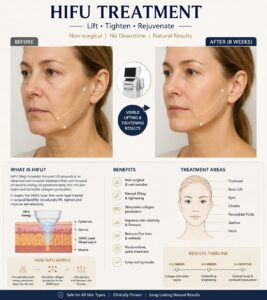
HIFU stands for High-Intensity Focused Ultrasound. It is a non-invasive aesthetic technology that delivers focused ultrasound energy into selected tissue depths to stimulate tissue contraction and collagen remodeling without making surgical incisions.
Unlike treatments that primarily work at the skin surface, focused ultrasound can deliver energy at predetermined depths beneath the skin.
The controlled thermal effect initiates a biological repair and remodeling response involving existing collagen as well as subsequent neocollagenesis and extracellular-matrix remodeling.
Research on microfocused ultrasound with visualization (MFU-V) has demonstrated treatment-related remodeling of collagen and elastin.
This is why focused ultrasound is commonly discussed as a non-surgical skin tightening and lifting treatment rather than simply a superficial facial.
How Does HIFU Tighten the Skin?
HIFU works by concentrating ultrasound energy at specific depths below the skin.
This produces controlled focal thermal coagulation points while largely sparing the intervening tissue.
The subsequent wound-healing response can stimulate:
- Collagen remodeling
- New collagen formation
- Elastin remodeling
- Improvement in tissue firmness
- Gradual tightening and lifting
- Improvement in certain aspects of skin texture and laxity
Depending on the device and treatment indication, different treatment depths may be selected to address different anatomical layers.
This ability to target tissue beneath the surface is one of the major differences between focused ultrasound and many conventional facial treatments.
What Is Microfocused Ultrasound With Visualization (MFU-V)?
One of the significant developments in ultrasound-based aesthetic treatment is Microfocused Ultrasound with Visualization, or MFU-V.
With ultrasound visualization, the treating physician can see relevant dermal and subdermal tissue layers and confirm treatment depth and appropriate transducer coupling.
This adds an important element of anatomical precision to ultrasound-based treatment.
For example, the FDA documentation for the Ulthera System describes ultrasonic visualization of dermal and subdermal tissue and its use in confirming treatment depth and appropriate coupling.
For patients researching terms such as HIFU vs Ultherapy, it is therefore important to understand that “HIFU” is often used broadly online, while individual ultrasound devices can differ substantially in their energy delivery, imaging capability, treatment depths, regulatory indications and clinical evidence.
A dermatologist should determine which technology and treatment protocol are appropriate for the individual patient.
What Are the Latest Advances in HIFU and Focused Ultrasound?
Focused-ultrasound aesthetics continues to evolve. Recent research has moved beyond the basic concept of “skin tightening” toward greater precision, regenerative effects, combination treatments and broader assessments of skin quality.
- Greater Treatment Precision
A major development is the increasing emphasis on precise energy delivery and anatomically appropriate treatment depths.
Ultrasound visualization in MFU-V allows assessment of tissue layers during treatment rather than relying exclusively on surface landmarks.
This is particularly relevant because facial anatomy varies considerably between individuals.
Modern treatment planning therefore increasingly focuses on:
right patient + right anatomical layer + appropriate energy + appropriate number and distribution of treatment lines.
- Better Understanding of Collagen and Elastin Remodeling
Recent research is providing a more detailed biological explanation for the gradual improvement seen after microfocused ultrasound treatment.
Histological research has demonstrated focal thermal coagulation at selected depths followed by processes associated with collagen and elastin remodeling.
This supports the concept of ultrasound treatment as a collagen-remodeling procedure, rather than a treatment that simply produces temporary tightening.
- HIFU and Regenerative Aesthetics
Another evolving concept is regenerative aesthetics.
Instead of focusing exclusively on filling wrinkles or adding volume, regenerative aesthetic strategies aim to stimulate biological processes that improve the structure and quality of ageing skin.
Microfocused ultrasound is increasingly being studied within this framework because controlled thermal stimulation can trigger extracellular-matrix remodeling and neocollagenesis.
- Improved Understanding of Overall Skin Quality
Modern aesthetic assessment is increasingly moving beyond a simple question: “Did the face lift?”
Researchers are examining broader dimensions of skin quality, including firmness, texture, surface evenness and other perceptual characteristics.
A 2025 narrative review examining MFU-V reported evidence supporting improvements particularly in firmness and surface-related parameters, while evidence for some other skin-quality characteristics remains more limited and emerging.
This represents an important change in aesthetic medicine: treatment success is increasingly assessed in terms of overall facial quality and natural appearance rather than dramatic alteration.
- Combination Treatments
Another important advance is multimodal facial rejuvenation.
One treatment cannot correct every component of facial ageing.
A patient may simultaneously have:
- Skin laxity
- Volume loss
- Dynamic wrinkles
- Changes in skin texture
- Pigmentation
- Reduced collagen
- Loss of facial definition
Therefore, appropriately selected patients may benefit from combining ultrasound-based tightening with other dermatologist-led procedures.
Depending on the individual, these may include:
Botulinum toxin | Dermal fillers | Biostimulators | Skin boosters | Lasers | Radiofrequency treatments | Chemical peels | Other collagen-stimulating procedures
Recent research has specifically examined combinations of MFU-V with calcium hydroxylapatite-based biostimulation. A 2025 systematic review found encouraging evidence for combined treatment, although the available studies and protocols remain heterogeneous and further research is needed.
Treatment sequencing is also becoming an area of investigation. A small pilot study examining MFU-V and hyperdilute calcium hydroxylapatite suggested that treatment order may influence outcomes, highlighting the increasing sophistication of combination-treatment planning.
Combination treatments should therefore be planned rather than indiscriminately stacked together.
Does HIFU Really Work?
Clinical evidence supports focused ultrasound as an option for appropriately selected patients with skin laxity, although outcomes vary according to the device, treatment protocol, anatomy, degree of laxity and patient characteristics.
A 2025 systematic review covering 45 clinical trials and cohort studies reported measurable improvements in skin tightening and body-contouring outcomes and generally favorable safety findings. The authors also emphasized the need for greater standardization of treatment protocols and further long-term research.
A separate systematic review and meta-analysis of MFU-V reported that 89% of evaluated patients demonstrated some degree of investigator-assessed global aesthetic improvement, while 84% reported improvement themselves. The researchers nevertheless highlighted limitations within the evidence base and the need for additional well-designed studies.
The appropriate expectation is therefore gradual, individualized improvement rather than a guaranteed surgical-level transformation.
Which Areas Can Be Treated With HIFU?
Depending on the technology, regulatory indication and individual anatomy, focused-ultrasound treatments may be considered for areas including the:
Lower Face
Useful when mild-to-moderate laxity is contributing to reduced facial definition.
Jawline
Treatment may help improve the appearance of early jowling and loss of jawline definition in appropriately selected patients.
Under the Chin
Focused ultrasound may be considered when submental laxity contributes to an ageing lower-face profile.
Neck
Collagen remodeling may improve the appearance of mild-to-moderate neck laxity.
Brow Area
Certain microfocused-ultrasound systems have indications for non-invasive eyebrow lifting.
Décolletage
Specific systems may be used to improve lines and wrinkles in the upper chest/décolletage.
Some focused-ultrasound technologies are also used for selected body skin-tightening and contouring applications. Regulatory indications differ between devices and countries.
HIFU for Jawline Tightening and Double Chin
“How can I tighten my jawline without surgery?” is one of the most common questions in aesthetic dermatology.
However, not every poorly defined jawline has the same cause.
Loss of definition may result from:
- Skin laxity
- Submental fat
- Jowling
- Facial volume changes
- Chin anatomy
- Muscle anatomy
- A combination of these factors
This distinction matters.
If the primary problem is laxity, focused ultrasound may be useful. If excess fat or skeletal structure is the dominant issue, HIFU alone may not produce the desired result.
A dermatologist-led facial assessment is therefore more important than simply selecting a treatment based on an online before-and-after photograph.
HIFU vs RF Skin Tightening: What Is the Difference?
Both HIFU and radiofrequency (RF) are energy-based treatments used in aesthetic dermatology, but they are not identical.
HIFU uses focused ultrasound energy, whereas RF treatments use radiofrequency energy.
The optimal treatment depends on the patient’s skin, anatomy, degree of laxity, treatment goals and the specific technology being considered.
In some patients, one modality may be preferable. In others, a carefully designed combination strategy may be appropriate.
There is therefore no universal answer to “HIFU or RF—which is better?”
The correct question is:
Which treatment is most appropriate for my anatomy and aesthetic concern?
HIFU vs Surgical Facelift
HIFU should not be presented as a replacement for a surgical facelift in every patient.
HIFU may be appropriate when:
The patient has mild-to-moderate skin laxity, prefers a non-surgical procedure, accepts gradual improvement and wants minimal disruption to normal activities.
Surgery may be more appropriate when:
There is significant tissue descent or advanced skin laxity and the patient requires a degree of lifting that non-invasive energy-based treatments are unlikely to achieve.
Setting realistic expectations is an essential component of responsible aesthetic treatment.
When Will I See Results After HIFU?
Some patients may notice an early feeling of firmness, but ultrasound-induced collagen remodeling develops progressively.
Changes are generally evaluated over the following weeks and months rather than immediately after treatment.
The extent and duration of improvement vary according to:
- Age
- Baseline skin laxity
- Collagen quality
- Treatment area
- Device used
- Treatment parameters
- Number and distribution of treatment lines
- Lifestyle factors
- Individual biological response
Maintenance treatment may be considered depending on the patient’s ageing pattern and clinical assessment.
Is HIFU Painful?
Sensation varies considerably between patients, treatment areas, devices and energy settings.
Patients may experience brief pulses of heat, tingling, tenderness or discomfort while ultrasound energy is being delivered.
In a 2025 meta-analysis of MFU-V studies, the pooled mean reported pain score was approximately 4.85/10, although there was considerable variation between studies.
A dermatologist can discuss expected discomfort and appropriate comfort measures before treatment.
Is There Downtime After HIFU?
One of the reasons HIFU is popular is that it is a non-surgical treatment with generally limited downtime.
Depending on the device and treatment intensity, temporary effects may include:
- Redness
- Mild swelling
- Tenderness
- Bruising
- Tingling or altered sensation
- Temporary discomfort
A systematic review of MFU-V reported that commonly described adverse effects were generally mild to moderate.
Rare or more significant complications are possible with energy-based procedures, particularly when treatment depth, anatomy or energy delivery is inappropriate. Proper patient selection and treatment by an appropriately trained medical professional are therefore important.
Who Is a Good Candidate for HIFU?
A suitable candidate is often someone who has mild-to-moderate skin laxity and wants gradual improvement without undergoing surgery.
HIFU may be considered for patients concerned about:
- Early jowls
- Reduced jawline definition
- Mild facial sagging
- Loose skin beneath the chin
- Mild neck laxity
- Age-related reduction in firmness
- Certain wrinkles and textural changes
However, suitability should be determined during consultation.
Who May Not Be Suitable for HIFU?
HIFU is not automatically appropriate for everyone.
Treatment may need to be avoided, postponed or modified depending on factors such as active skin infection, wounds in the treatment area, certain implants or medical devices, significant underlying medical conditions, pregnancy considerations, previous procedures, facial anatomy or unrealistic expectations.
A complete history and examination should therefore precede treatment.
Why Dermatologist-Led HIFU Treatment Matters
Energy-based aesthetic treatments are highly dependent on anatomy, patient selection, device characteristics, treatment depth and energy parameters.
The face contains nerves, blood vessels, muscles, fat compartments and bony structures at varying depths.
Effective treatment therefore involves more than simply moving a HIFU handpiece over the skin.
A dermatologist can evaluate:
- What is actually causing the patient’s concern?
- Is skin laxity the main problem?
- Which anatomical layer should be targeted?
- Is focused ultrasound the most appropriate treatment?
- Would another procedure—or a combination approach—produce a better result?
- Are there medical reasons to modify or avoid treatment?
This assessment is particularly important for patients seeking a natural-looking non-surgical facelift.
HIFU Treatment in Dadar, Mumbai at Sskin Savvy Advanced Aesthetics
For patients searching for HIFU treatment in Mumbai, HIFU treatment in Dadar, skin tightening treatment in Dadar, non-surgical facelift in Mumbai, or a dermatologist for HIFU in Mumbai, consultation is available at:
Sskin Savvy Advanced Aesthetics
Dr Usha Beloskar
Board-Certified Dermatologist
Sskin Savvy Advanced Aesthetics is located at Kohinoor Square, Dadar West, Mumbai. The clinic provides dermatologist-led aesthetic care including facial rejuvenation, HIFU and other advanced aesthetic procedures. The clinic’s website describes Dr Usha Beloskar as having more than 26 years of expertise and experience with advanced lasers, anti-ageing procedures, facial rejuvenation and non-surgical facelift technologies.
Clinic Address
Kohinoor Square, Central Tower B, 403, 4th Floor, opposite Sena Bhavan, Dadar West, Mumbai – 400028
Appointments
98218 80678
89609 60962
99309 80678
Website: Sskin Savvy Advanced Aesthetics
Instagram: @dr_ushadermat
Frequently Asked Questions About HIFU Treatment
Is HIFU good for skin tightening?
HIFU and microfocused ultrasound can improve skin firmness and laxity in appropriately selected patients by producing controlled thermal stimulation at targeted tissue depths and triggering collagen remodeling.
Can HIFU give me a non-surgical facelift?
HIFU can produce gradual lifting and tightening in selected patients, particularly those with mild-to-moderate laxity. It should not be expected to reproduce the magnitude of a surgical facelift in patients with advanced tissue sagging.
Is HIFU good for the jawline?
It can be useful when reduced jawline definition is partly caused by skin laxity. A clinical assessment is necessary because submental fat, jowls, volume loss and skeletal anatomy can also affect jawline definition.
Can HIFU reduce a double chin?
It depends on why the double chin is present. Skin laxity and excess submental fat are different problems. A dermatologist should identify the predominant cause before recommending treatment.
How many HIFU sessions are required?
There is no universal number. Treatment frequency depends on the technology used, degree of laxity, age, treatment area and individual response. Some protocols involve a single treatment followed by reassessment, whereas other technologies and clinical situations may require a different schedule.
How long do HIFU results last?
Results vary between individuals because natural ageing continues after treatment. Collagen remodeling develops gradually, and maintenance requirements depend on age, skin quality, treatment parameters and lifestyle.
At what age should you start HIFU?
There is no single “correct” age. Clinical indication is more important than chronological age. A dermatologist should assess skin laxity, facial anatomy and treatment goals before recommending HIFU.
Is HIFU safe for Indian skin?
Because focused ultrasound delivers energy below the epidermal surface, it does not work through the same pigment-targeting mechanism as many lasers. However, suitability and treatment parameters still require individual assessment. Research on MFU-V includes evidence in a range of Fitzpatrick skin types, including darker skin types.
Is HIFU better than Botox or fillers?
They treat different components of facial ageing. Botulinum toxin primarily addresses selected muscle-related dynamic wrinkles; fillers can restore or modify volume and contours; focused ultrasound primarily targets tissue tightening and collagen remodeling. They may sometimes form different components of a comprehensive treatment plan.
What is the latest development in HIFU?
Important recent developments include microfocused ultrasound with visualization, greater anatomical precision, improved understanding of collagen and elastin remodeling, broader skin-quality assessment, advanced treatment protocols and evidence-based combination approaches with biostimulatory treatments.
The Future of HIFU in Aesthetic Dermatology
The direction of HIFU research is increasingly toward personalized and anatomically precise treatment.
A 2026 analysis of the HIFU literature found that research into non-invasive facial rejuvenation and body contouring continues to expand, while also emphasizing important evidence gaps involving standardized treatment parameters, long-term outcomes and patient-reported measures.
The future is therefore unlikely to be simply “stronger HIFU.”
It is more likely to involve:
better imaging + better anatomical targeting + individualized energy delivery + improved treatment protocols + combination therapy + objective outcome measurement.
There is also emerging research into completely different dermatological applications of high-frequency focused ultrasound, including treatment of selected cutaneous lesions. These applications remain distinct from routine cosmetic facial HIFU and require appropriate clinical evidence and medical indications.
Considering HIFU Treatment in Mumbai?
If you are concerned about facial sagging, loose skin, early jowls, reduced jawline definition, neck laxity or other signs of facial ageing, the first step should be an assessment of what is actually causing the change.
The most appropriate treatment may be HIFU, another energy-based technology, injectables, collagen-stimulating treatment—or a carefully planned combination.
At Sskin Savvy Advanced Aesthetics, Dadar West, Mumbai, Dr Usha Beloskar provides individualized dermatology and aesthetic treatment planning based on the patient’s skin, facial anatomy and treatment goals.
Sskin Savvy Advanced Aesthetics
Dr Usha Beloskar
Board-Certified Dermatologist
📞 98218 80678
📞 89609 60962
📞 99309 80678
Address: Kohinoor Square, Central Tower B, 403, 4th Floor, opposite Sena Bhavan, Dadar West, Mumbai – 400028
Medical disclaimer: This article is intended for general educational information and does not replace an in-person medical consultation. Results, suitability risks and treatment protocols vary between patients and devices.